


The story of network modernisation is usually told through what comes next, from faster fibre and wider 5G coverage to greater data centre capacity and the infrastructure needed to carry growing demand for connectivity, cloud, mobile and critical services.
But every upgrade and rollout also creates a second story, about the technology that leaves the network behind. Equipment that is no longer needed in one part of the infrastructure has not necessarily reached the end of its useful life, and the assets coming out of a network can support another deployment, avoid unnecessary manufacturing, deliver a commercial return and keep valuable metals within the UK economy.
How retired network technology is handled affects carbon performance and informs procurement, which is where sustainability goals meet day-to-day operations.
For David Evans, Chief Product and Asset Recovery Officer at TXO, the priority is ensuring organisations have the processes, data, and expertise in place to capture the opportunity.
“Every network upgrade raises the question of what happens to the equipment coming out of service. Recovery, reuse, resale, and recycling need to be considered earlier in network strategy, so that more of that value can be retained.”
Turning retired equipment into measurable impact
TXO’s long-term work with Virgin Media O2 shows the scale of this approach. Over the last 10 years, the partnership has avoided 5,262 tonnes of CO₂e by keeping retired network equipment in use rather than replacing it, the equivalent of taking more than 1,100 cars off the road for a year.
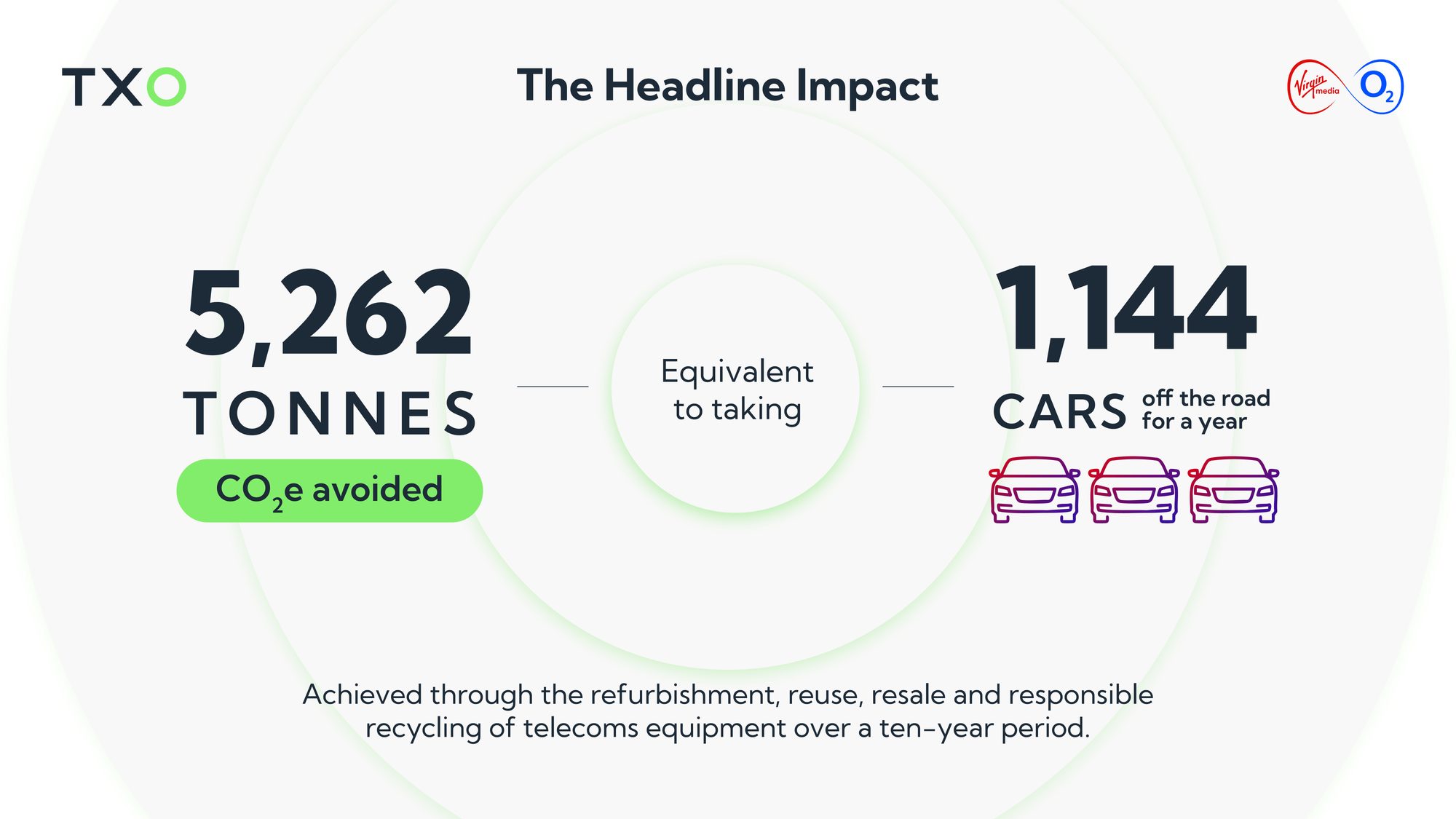
The largest share of that saving, 4,575 tonnes of CO₂e, came from refurbishing recovered assets such as switches, routers and line cards and returning them to the telecoms market. A further 687 tonnes came from Virgin Media O2 sourcing replacement equipment through the secondary market rather than buying new.
Paul Franey, Head of Reverse Logistics at Virgin Media O2, said:
“Our network is at the heart of the services we provide to millions of customers every day. That means we have a responsibility to manage the technology behind it in a way that supports performance, resilience, and long-term sustainability.
“Working with TXO gives us the visibility and specialist support to understand where equipment still has a role to play beyond its original deployment. That helps us protect value, reduce unnecessary purchasing, and give more technology a second life as part of a more resilient and responsible network strategy.”
Where equipment has genuinely reached the end of its working life, the programme keeps material out of landfill, and over the same decade TXO has recycled more than 690 tonnes of Virgin Media O2’s equipment, roughly the weight of 50 double-decker buses.
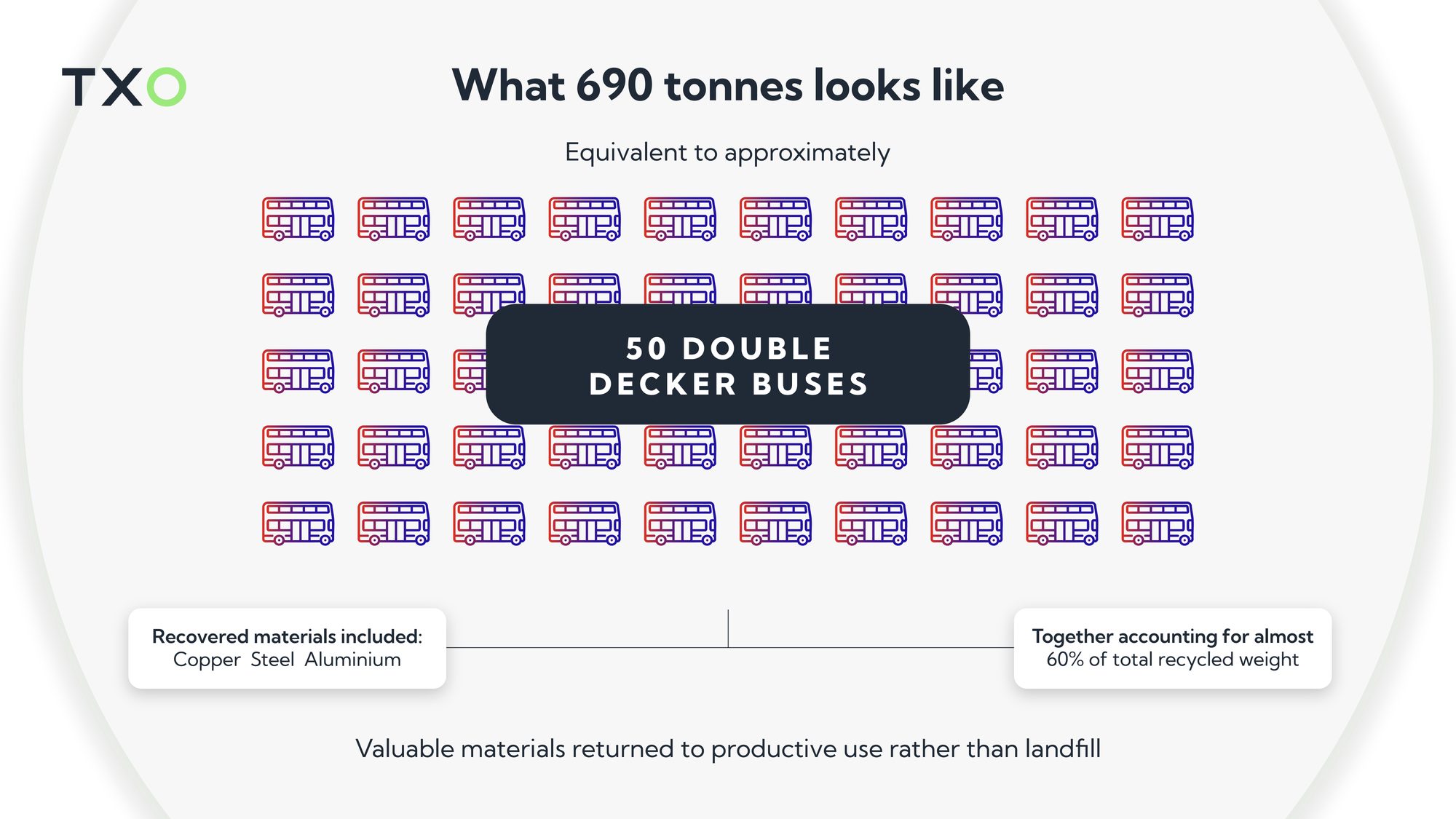
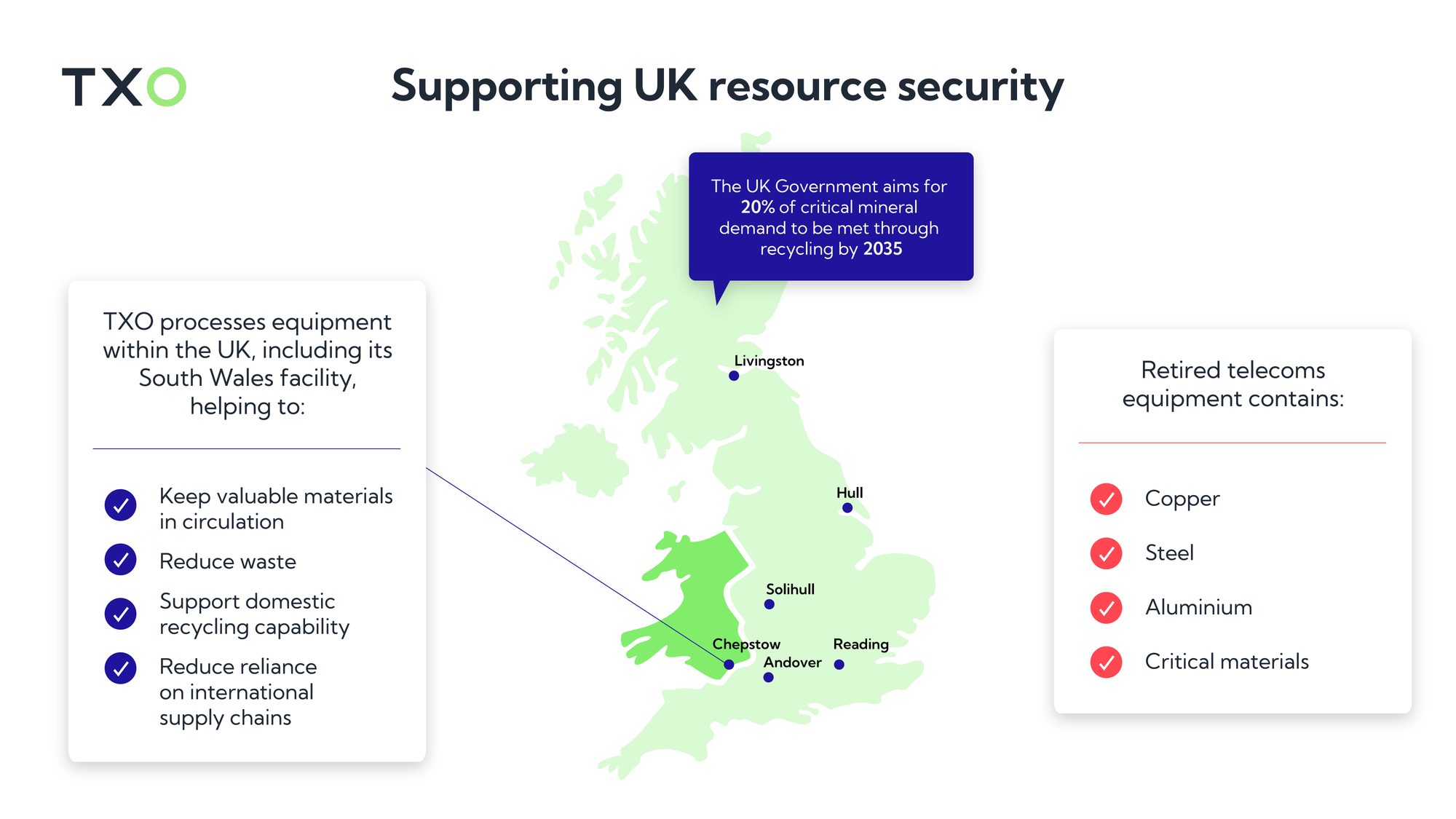
The material recovered includes cable, power packs, routers, switches, and processor boards, with steel, aluminium, and copper accounting for almost 60 per cent of the total recycled weight. By recovering and processing assets in the UK, including at its South Wales facility, TXO supports the direction of the UK Government’s Critical Minerals Strategy, Vision 2035, which sets out ambitions to increase domestic recycling capability, reduce reliance on international supply chains and meet 20 per cent of UK critical mineral demand from recycling by 2035.
The partnership also supports Virgin Media O2’s Responsible Business Plan by contributing to its focus on circularity and extending the life of technology across devices, networks, and infrastructure. It gives the secondary market a more strategic role, helping to keep hardware available while giving equipment a life beyond its first deployment.
Making circularity measurable
Confident planning depends on strong data, and TXO’s Carbon Calculator, developed with global climate consultancy the Carbon Trust and built into its i-TRAC asset management platform, was designed to quantify circular choices across procurement, asset recovery, decommissioning, and lifecycle management. It measures the CO₂e saved by buying refurbished equipment and the emissions avoided by reselling surplus assets, then sets those figures alongside the financial return.
Aleyn Smith-Gillespie, Director and Global Head of ICT at the Carbon Trust, said:
“Extending the life of products through better design, recycled content, and reuse, repair and refurbishment is a core decarbonisation lever for ICT and telecom companies, but the challenge is quantifying these emission savings and demonstrating their impact. That’s precisely where the carbon calculator can support decisions.”
David Evans added:
“When organisations can see carbon impact alongside commercial return and material recovery, they can make more informed circular decisions. That is what turns second-life technology from a sustainability ambition into something that can be planned, managed, and measured.”
With the right expertise, evidence and route to market, retired network technology can keep working long after it leaves its first deployment. Its first life may be over, but its value does not have to be.
You might be interested in:
Beyond the €30-40bn cost: what happens when network infrastructure has to be replaced?
Replacing network infrastructure at scale is about much more than procuring new technology. Operators also need to consider resilience, migration, decommissioning and what happens to infrastructure once it leaves the network.
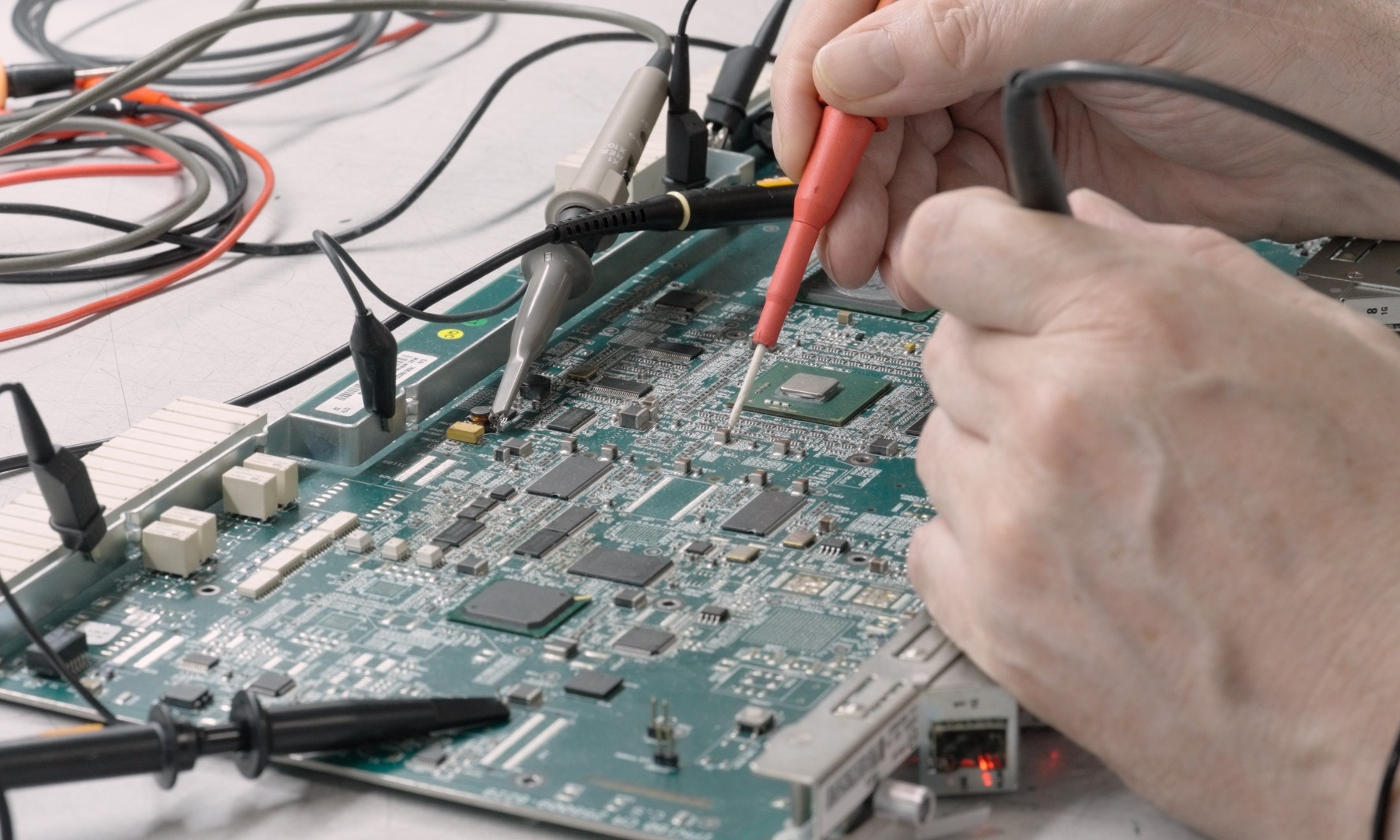
See how TXO keeps networks running longer with expert test & repair engineering
In our new video, go inside TXO’s Solihull repair lab with Lead Electronics Engineer Dave Wise and discover how our team brings network hardware back to life with precision engineering and rigorous testing.
TXO’s Carbon Calculator: How reuse creates measurable carbon savings in network infrastructure
Discover how TXO’s Carbon Calculator, developed with the Carbon Trust, helps organisations turn refurbishment and reuse into measurable carbon savings. By revealing the hidden emissions avoided through reuse, the calculator gives operators the data they need to make smarter, more sustainable network infrastructure decisions.