

Organisations upgrading their networks face a familiar dilemma: how to modernise critical infrastructure without inflating the carbon footprint of procurement. One of the largest and most overlooked contributors to Scope 3 emissions is the manufacturing of new network equipment. It’s energy-intensive, resource-heavy, and often hidden behind supply-chain complexity.
TXO’s Carbon Calculator, created working with the Carbon Trust, brings transparency to this challenge. By quantifying the emissions avoided through refurbishment and reuse, it gives operators a credible way to measure the environmental value of circular technology strategies.
Why measuring reuse matters
TXO specialises in giving network equipment a second life; sourcing pre‑owned products, cleaning and refurbishing them, and returning them to market in fully functional condition.
This approach delivers substantial environmental benefits. Every refurbished unit represents:
- Avoided manufacturing emissions
- Reduced electronic waste
- Extended asset life
- Lower demand for raw materials
But until now, quantifying these benefits consistently has been difficult. TXO’s Carbon Calculator changes that by applying a robust lifecycle carbon assessment model to every product category.
How the TXO Carbon Calculator works
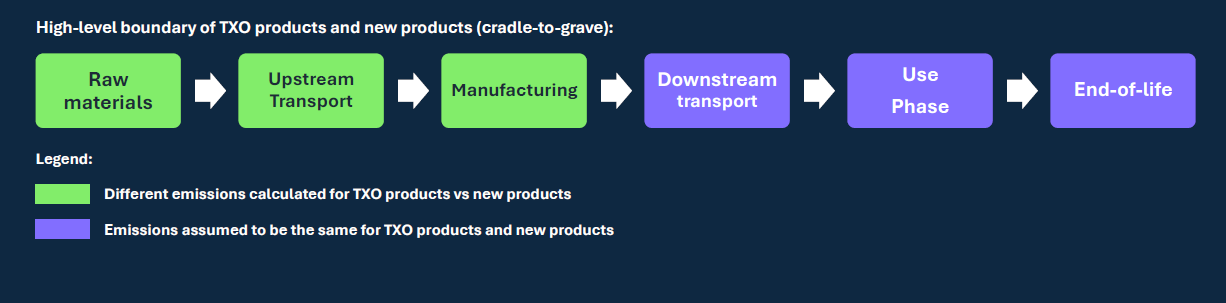
The model compares two separate carbon footprints for each product category:
- The lifecycle CO₂e emissions of a new product
- The lifecycle CO₂e emissions of the same product after being cleaned and/or refurbished by TXO following its first use
The carbon savings achieved through refurbishment are calculated as the difference between these two footprints.
Lifecycle CO₂e refers to the greenhouse gas emissions generated across a product’s lifecycle, expressed as carbon dioxide equivalent (CO₂e). This includes emissions associated with manufacturing, transportation, refurbishment, usage, and end-of-life treatment.
A robust and credible methodology
The TXO Carbon Calculator and underlying calculations were developed in collaboration with the Carbon Trust, a globally recognised authority in decarbonisation.
Working closely with The Carbon Trust ensures the methodology aligns with current best practice in lifecycle carbon measurement, providing customers with a transparent, credible, and governed approach to carbon reporting.
Supporting sustainable infrastructure transformation
For operators modernising networks, refurbishment isn’t just a cost‑effective procurement strategy. It’s a powerful lever for reducing Scope 3 emissions and meeting ESG commitments.
“The TXO Carbon Calculator brings greater visibility to the environmental value of investment recovery, helping Colt quantify the benefits of extending the lifecycle of network equipment. This supports both our sustainability goals and our broader efforts to embed circularity into operations,” said Marta Trzaska, Sustainability Lead Specialist: Environment & Social Impact at Colt.
By choosing refurbished equipment, organisations can:
- Reduce demand for new manufacturing
- Lower embedded carbon emissions
- Cut electronic waste
- Advance circular economy goals
- Unlock value from retired assets
TXO’s circular model allows customers to align sustainability ambitions with operational and commercial benefits, without compromising network performance.
“One of the biggest opportunities for reducing emissions in infrastructure is avoiding unnecessary manufacturing in the first place. By quantifying the carbon savings linked to refurbishment and reuse, we’re helping customers see circularity as a practical and measurable sustainability strategy,” said Natalia Ferenc, Group ESG Analyst at TXO.
From sustainability goals to measurable impact
As organisations face increasing pressure to demonstrate measurable environmental progress, accurate lifecycle carbon data is becoming essential.
TXO’s Carbon Calculator provides a practical way to quantify the environmental impact of refurbishment and reuse, helping organisations make more sustainable procurement decisions backed by credible data.
More than a reporting tool, the calculator demonstrates how circular technology strategies can reduce emissions, extend asset life, and deliver measurable environmental impact at scale.
You might be interested in:

Why spend-based carbon accounting could be holding back your net zero strategy
If you’re relying solely on spend-based carbon accounting using the EEIO method, you could be underestimating the carbon savings delivered through circular procurement. Discover how TXO helps organisations measure the environmental impact of circular procurement, refurbishment and asset recovery, supporting Science Based Targets (SBTi) and accelerating progress towards net zero.

Powering Net Zero: How TXO turns Scope 3 challenges into local opportunity
Net zero is a global ambition, but its impact is felt locally. Across the essential systems that keep people connected, safe and powered, TXO helps organisations cut their Scope 3 emissions while creating skills, jobs and opportunity in the communities they serve.

Delivering the future for Virgin Media O2
A proud milestone for TXO as we officially open our Hull operation and celebrate the beginning of an exciting new chapter with Virgin Media O2 (VMO2). Great partnerships, talented people, and strong collaboration are already driving success.