

Challenge
NATS required a resilient connectivity solution for its Durris Hill Wide Area Multilateration (WAM) site. The project presented several key challenges:
- Identifying a technically viable transmission path between Durris Hill and the Aberdeen Control Tower.
- Assessing line-of-sight feasibility and radio path performance across varied terrain. Due to active flight path proximity and associated airspace constraints near the airport, standard optical line-of-sight (LoS) laser techniques could not be deployed. Consequently, TXO conducted an alternative long-range (30km) photogrammetric LoS survey utilising telephoto optical systems while dynamically mitigating adverse weather conditions.
- Identifying suitable relay sites where a direct point-to-point link was not achievable.
- Evaluating existing telecommunications infrastructure to minimise the requirement for new installations.
- Balancing technical performance, resilience, and cost to deliver the optimum network design.
- Producing a scalable solution capable of supporting future operational and network requirements.

Solution
TXO designed and delivered a resilient microwave connectivity solution to provide a high-capacity link between the Durris Hill WAM site and the Aberdeen Control Tower.
Key elements of the solution included:
- Designing a point-to-point microwave link using NEC iPASOLINK VR4 radios,configured in a 1+1 Hot Standby redundancy arrangement to maximise service availability.
- Utilising an existing NATS telecommunications tower near Aberdeen as the termination point for the Durris Hill link, eliminating the need to secure additional relay sites or third-party tower infrastructure.
- Managing the site-sharing application with Cellnex for the Durris Hill installation and coordinating closely with the site provider throughout the project to facilitate timely access and deployment.
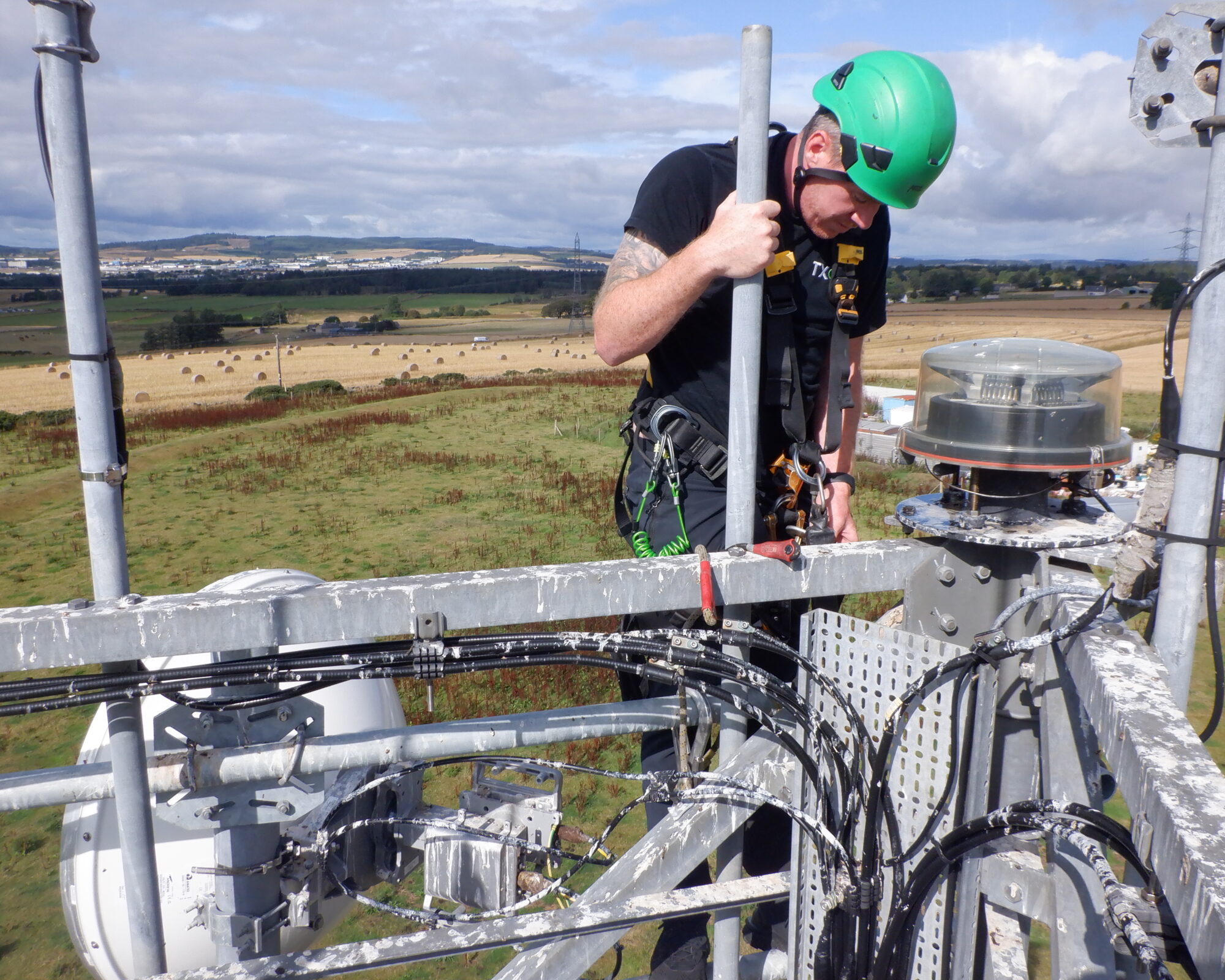
- Designing and procuring bespoke fabricated steelwork to support the microwave installation on the existing NATS tower, ensuring compliance with structural and installation requirements.
- Undertaking the complete radio frequency planning and Ofcom licensing process, including coordination with Ofcom to resolve spectrum availability issues. Following the identification of interference and frequency constraints within the initially proposed band, an alternative licensed frequency was successfully selected to ensure reliable operation.
- Producing a resilient, standards-compliant solution that minimised new infrastructure requirements while providing a reliable communications path for the Durris Hill WAM site.

Results
- Reliable, high-capacity connectivity established to support the operational requirements of the NATS Wide Area Multilateration (WAM) network.
- High-availability communications achieved through the deployment of NEC iPASOLINK VR4 radios configured in a 1+1 Hot Standby redundancy arrangement.
- Efficient utilisation of existing NATS infrastructure, eliminating the need for additional relay sites and reducing project complexity and cost.
- Successful coordination of site-sharing, bespoke structural works, and Ofcom spectrum licensing to enable timely project delivery.
- Reinforced TXO’s capability to deliver complex, end-to-end microwave communications solutions for critical aviation infrastructure.

Conclusion
The Durris Hill project demonstrates TXO’s capability to design and deliver resilient microwave communications solutions for critical aviation infrastructure. By combining detailed radio path analysis, robust network design, and effective project management, TXO successfully delivered a reliable connectivity solution tailored to NATS’ operational requirements.
The successful deployment highlights TXO’s expertise in managing the complete project lifecycle—from feasibility studies and radio frequency planning through to site coordination, structural design, spectrum licensing, installation, and commissioning. Through close collaboration with NATS, Cellnex, and Ofcom, TXO delivered a high-availability solution while minimising new infrastructure requirements and ensuring long-term operational resilience
You might be interested in:

Reliable 21CN connectivity delivered to Sumburgh Airport in the Shetland Islands for NATS
NATS, the UK’s leading provider of air traffic control services, required a new 21CN connection to support operations at Sumburgh Airport. TXO extended NATS’ existing Shetland microwave network with a new point-to-point link, overcoming OFCOM licensing delays and coordination challenges to deliver resilient, high-capacity connectivity in one of the UK’s most remote regions.

Engineering the critical communications behind offshore wind substations
Offshore wind infrastructure demands specialist engineering, rigorous testing and seamless integration. Discover how TXO brought these capabilities together across a complex, multi-year programme spanning three new-build offshore substations, delivering integrated telecoms solutions on time and within budget.

Why the future of technology depends on investing in people
Long-term technology performance depends on more than systems and infrastructure. It depends on the people who understand how those systems behave in real-world conditions and how they can be transformed and optimised effectively.